Weaponised Surveillance: Ethiopia’s Digital War on Women Human Rights Defenders

Meskerem Abera, an Amhara nationalist activist, launched Ethio Nikat Media, a YouTube-based news channel, while teaching at Hawassa Teachers College in southern Ethiopia in 2022. Within a year, she had over 48,000 subscribers. Then, in 2023, she became one of at least eight journalists and human rights defenders arrested on allegations ranging from inciting violence to undermining state authority.
While in detention, recordings of her deeply personal conversations were leaked online and submitted as evidence in court. Her case marked a chilling shift: wartime-grade surveillance tools, once used primarily for political repression, are now deeply embedded within Ethiopia’s domestic justice system.
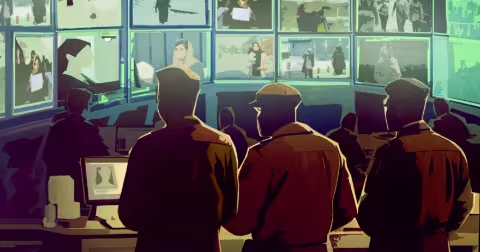
Surveillance in Ethiopia has evolved beyond a mere function of the state—it has become a central strategy of governance. When deployed against women, its effects are particularly devastating. Tools once reserved for military intelligence—call interception, movement tracking, metadata harvesting—are now used to intimidate, humiliate, and silence women human rights defenders (WHRDs).
The gendered dimensions of this surveillance are especially insidious. Leaked recordings, often decontextualised or manipulated, are distributed by coordinated networks of pro-government digital actors. These materials disproportionately target women, weaponising misogyny and digital gender-based violence to undermine their credibility.
“It’s not just about politics,” said one WHRD, speaking anonymously due to safety concerns. “It’s about humiliation. They turn our private lives into weapons.”
This ecosystem thrives on fear. Surveillance doesn’t merely extract information—it amplifies vulnerability, intersecting with deep-rooted misogyny, stigma, and social exclusion.
Weaponised leaks
Personal phone calls, once assumed private, frequently surface on social media—stripped of context and strategically timed to inflict reputational damage. These leaks rarely come from formal institutions. Instead, they’re disseminated by quasi-influencers and government-aligned digital actors.
One prominent figure is Natnael Mekonen, a former TPLF critic turned government supporter, with large Telegram and Facebook followings. Natnael frequently posts graphic war content and intercepted audio clips from private conversations, primarily targeting civil society actors. He is part of a larger network of digital enforcers with privileged access to surveillance data.
This tactic was clearly seen in 2023 when opposition leader Dr. Chane Kebede was arrested after a leaked phone call allegedly showed him sharing military intelligence with Amhara rebels. The recording, almost certainly obtained without a warrant, pointed to the erosion of legal safeguards and the normalisation of extrajudicial surveillance.
Legacy of control, reinvented for the digital age
Surveillance in Ethiopia has long been an elite practice, deeply embedded in the country’s political history. During the TPLF-dominated era, the government routinely attempted to monitor foreign-based opposition groups, while simultaneously turning surveillance inward to keep tabs on internal rivals. In the waning days of TPLF dominance, factional infighting spilled into the digital realm—private online activities of high-ranking figures like Debretsion Gebremichael were leaked as political weapons. At the height of its power, the TPLF institutionalized surveillance through the “one-to-five” grassroots structure, a neighborhood-level monitoring system designed to extend state oversight into the most intimate corners of daily life.
Although this manual surveillance network was officially dismantled after 2018, its legacy persists—transformed rather than eliminated. What was once analog has now gone digital. Today’s surveillance culture is more fragmented, but arguably more invasive and difficult to trace. The architecture of surveillance now includes a wide array of actors: national telecom authorities, federal and regional security agencies, regional militias, and even diaspora propagandists. The boundaries between state security, political retribution, and personal vendetta have become dangerously fluid.
State-aligned hackers and coordinated networks of social media trolls have become central players in Ethiopia’s evolving surveillance landscape. These actors routinely impersonate journalists, infiltrate email accounts, and leak private messages—not for public accountability, but to intimidate, discredit, and silence. Surveillance today is no longer the exclusive domain of the state; it has morphed into a diffuse, Weaponised ecosystem, where intimidation operates through both official and unofficial channels.
Surveillance as a weapon of domestic warfare
Ethiopia’s surveillance is nominally governed by two laws; the Telecom Fraud Offenses Proclamation and the Computer Crime Proclamation. But in practice, legal safeguards are weak and enforcement tends to protect state interests. Warrantless surveillance is routine, and the judiciary provides little oversight.
This was evident in the police raid on the offices of Addis Standard, a respected independent media outlet. In a post on X (formerly Twitter), publisher Tsedale Lemma warned that confiscated electronics left their communications vulnerable. “The use of these devices outside our control presents serious risks not only to our staff’s safety but also to the integrity of our journalistic work,” she warned.
When contacted afterward, Tsedale added: “The team during the raid was told the police had been surveilling their activities for days before. I found it perplexing—though not surprising. I hesitate to say more without endangering the team.”
The gendered toll of digital repression
Women human rights defenders face compounded threats, navigating layers of surveillance intertwined with gendered abuse. One prominent woman journalist, speaking anonymously, noted, "We don’t just fear surveillance for political reasons—it feels intensely personal, intrusive in ways men may not fully grasp. Our private lives become ammunition."
Another woman journalist and human rights defender, also speaking anonymously, revealed, "They release intimate conversations to silence us. It's psychological warfare—knowing your most private moments can be Weaponised publicly."
Detailed case studies highlight these profound psychological impacts. Journalist Rahel (name changed), who fled Ethiopia after persistent digital threats, described experiencing anxiety attacks whenever her phone rang. "Every notification was terrifying," she explained. "I couldn’t sleep without constantly checking if my private messages had been leaked online. The fear invaded every aspect of my life."
Another journalist, Sofia (name altered for anonymity to avoid reprisal), described being blackmailed by anonymous online actors who threatened to expose personal details unless she ceased critical reporting. "The threat wasn't only professional—it destroyed my sense of safety and trust," she recounted. "I felt completely vulnerable, even within my own home."
The current surveillance landscape is less centralized, more fragmented, and arguably more dangerous. Armed groups, opposition networks, and government agencies alike now participate in digital surveillance, often weaponising social media to track critics. These campaigns have, in some cases, led to physical harm. In 2021, humanitarian aid worker Yared was abducted and killed in the Amhara region by armed non-state actors who closely monitored his online activities. Similarly, journalist Sisay Fida, working for the Oromia Broadcasting Network, faced intense digital surveillance and threats from armed groups before being murdered in Dembi Dollo. These tragic cases illustrate how surveillance by both state and non-state actors can escalate into physical violence, profoundly affecting journalists and activists alike.
Beyond politically motivated surveillance, an investigation by Shega Media revealed a digital underworld where non-state actors and individuals exploit young women by non-consensually sharing intimate images. Some of these images are obtained through surveillance, the confiscation of personal devices, theft, or by tricking individuals into sharing them under false pretenses. Telegram channels operate profitably, offering tiered access to explicit content, exacerbating gender-based violence and exploitation. This clandestine industry intensifies psychological trauma, isolation, and public humiliation among women, particularly impacting journalists and activists.
Shega Media’s reporting documented over a dozen Telegram channels that marketed themselves as both entertainment and blackmail venues. They offered subscription-based access to sexually explicit content, including images stolen or coerced from young women. One woman whose images were circulated told Shega, "I had to leave school. I couldn't face anyone. I still don’t know who did it or how they got the pictures." The sense of powerlessness, combined with the absence of legal protection or institutional redress, contributes to a pervasive atmosphere of fear.
One recent flashpoint that captured national attention came from a segment aired on the welfare programme New Chapter on EBS TV. In the broadcast, a woman described being kidnapped and gang raped while she was a university student. The segment triggered a wave of public empathy, especially given the programme’s wide reach among working- and middle-class Ethiopians.
But within hours of the broadcast, pro-government influencers began releasing fragments of alleged evidence suggesting the woman had conspired to fabricate the story. Their confidence in the collapse of her credibility was striking. Some even predicted, accurately, that state media would soon air a counter-narrative. These actors hinted at access to recordings not yet public, raising questions about how the material had been obtained.
One plausible explanation is unauthorized access to telecommunications data—either through real-time interception or via state-linked archives. In short order, Ethiopian state television aired audio purportedly capturing the woman and an accomplice discussing plans to manipulate public opinion. Though some supporters of the woman claimed the recordings were manipulated, independent analysts found no definitive evidence of fabrication. What alarmed many was not the content of the tapes but the speed, coordination, and ease with which private speech became public spectacle.
The broader impact is not just legal but psychological. “The knowledge that we are being listened to has a damaging psychological impact on human rights defenders and journalists,” said Befeqadu Hailu, a seasoned analyst of Ethiopian political life. “The bad thing is not only that people like journalists and activists can’t safely talk about their work—they can’t even talk to their partners over regular phone lines. There’s a high chance someone is listening.”
As Ethiopia grapples with internal conflict, deepening political fragmentation, and an information ecosystem saturated with distrust, the boundary between surveillance and propaganda is steadily dissolving. Each leaked conversation, orchestrated smear campaign, and strategically timed exposure constricts the already fragile space for democratic discourse. Yet this narrowing of civic space is not merely ideological—it is rooted in the country’s digital infrastructure and the stark inequities that shape who can communicate securely and who cannot.
Encryption for the privileged few
Encrypted messaging apps like Signal and WhatsApp have become indispensable—not just for organizing activism, but for the most basic forms of communication. However, access to these tools is far from universal. In practice, secure digital communication is often the preserve of those with the means, knowledge, and language support to navigate it. This digital divide has turned encryption itself into a form of privilege. A former high-ranking government insider, who requested anonymity, revealed that senior officials—including former Deputy Prime Minister Demeke Mekonnen—regularly use Signal with auto-delete features to protect sensitive communication. “Even within government circles,” the source admitted, “mistrust runs deep. Everyone is watching everyone else.”
This mistrust is mirrored—and magnified—outside the halls of power, where the capacity to defend against digital surveillance remains uneven. As surveillance technologies become more sophisticated, the tools meant to resist them remain inaccessible to those most vulnerable. While government officials, NGO personnel, and urban elites in Addis Ababa routinely use encrypted platforms, journalists, human rights defenders, and grassroots activists—especially in rural and marginalized communities—are often left without the devices, training, or linguistic resources necessary to protect themselves.
“Even if I wanted to use Signal, I wouldn’t know where to start,” said Lensa, an Oromo rights activist based in Addis Ababa. “No one’s teaching us, and the guides I’ve found aren’t even in our language. I hear government people use it all the time to protect themselves—why not us?”
Digital rights resources such as the Electronic Frontier Foundation’s Surveillance Self-Defence guide or Tactical Tech’s toolkits were once lifelines for at-risk groups. Today, however, their impact is limited: seldom updated in Amharic and almost entirely unavailable in Oromo or Tigrinya. This linguistic exclusion compounds systemic vulnerability, further marginalizing those already on the frontlines.
For many independent journalists, the challenge is not just technical—it’s existential. “I know my phone isn’t secure,” said a reporter from an Amharic-language outlet, speaking anonymously. “But I can’t afford another device, and I don’t have time to learn encryption when I’m already racing deadlines and watching my back.”
The result is a stratified digital environment—those who can encrypt, and those who cannot. In Ethiopia, where surveillance is both a tool of repression and a public performance of control, digital protection is no longer just a matter of security. It is a marker of privilege, shaping who gets to be heard and who is forced into silence. It draws the line between visibility and vulnerability, between survival and erasure.
Resilience in the shadows
As the boundary between surveillance, propaganda, and personal violation continues to blur, Ethiopia’s social fabric is increasingly strained. Yet even in the face of such pervasive repression, resistance persists. “They surveil us to silence us,” said one defiant woman journalist. “But our stories, our voices—those they can’t fully control.” Her words speak to a deeper tension: while surveillance seeks to suppress dissent, it also reveals the regime’s fear of losing control over narrative and meaning.
What sets Ethiopia’s surveillance architecture apart is the way it seamlessly fuses monitoring and messaging. At the local level, government authorities are encouraged—even expected—to maintain a digital presence on platforms like Facebook. On the surface, these pages serve to highlight development projects, promote public services, and foster community engagement. But beneath that veneer of transparency lies another purpose: identifying and tracking dissent. Public relations officers working in district offices are quietly instructed to “highlight the good and quietly flag the bad,” as one media trainer put it. “It’s about narrative control, not just public communication.”
This digital transformation initiative, framed as progress, functions in practice as a containment strategy. The platforms designed to foster civic participation double as tools of surveillance. Engagement is not merely measured in likes or comments—it is parsed, categorized, and used to map political risk. In this environment, every post, every comment, every shared article becomes potential evidence. The appearance of openness masks a deeper logic of control. These platforms don’t just shape how stories are told—they help determine who gets to tell them.
What began under the TPLF as a strategy to monitor opposition groups abroad has since evolved into a far more expansive—and increasingly audacious—campaign. While the transnational reach of Ethiopia’s surveillance apparatus is not entirely new, its scope has deepened in troubling ways. Years ago, exiled Ethiopian journalists were targeted with commercial spyware such as FinFisher, prompting concern among international press freedom organisations. But what was once focused on silencing diaspora critics has now escalated into attempts to spy on foreign governments themselves.
In 2023, U.S. State Department employee Abraham Teklu Lemma was charged with passing classified Defence information to the Ethiopian government. The case, still under investigation, underscores just how far the surveillance state is willing to go—and how dangerously blurred the lines have become between national security objectives and covert geopolitical interference. Ethiopia’s surveillance ambitions now extend well beyond its borders, raising urgent questions about the country’s role in the global landscape of digital authoritarianism.
As digital surveillance expands alongside Ethiopia’s internal conflicts, the line between national security infrastructure and tools of gender-based control becomes harder to define. Technologies designed for counterinsurgency—from metadata interception to drone-enabled facial recognition—are being refitted for domestic use. For WHRDs, these wartime tools morph into instruments of intimate, sustained harm. Their phones, their bodies, and their relationships are all made legible to a state that increasingly governs through exposure and fear.
Digital rights advocates say Ethiopia’s evolving surveillance infrastructure reflects a broader global trend. “This isn’t just about Ethiopia—it’s part of a global shift toward digital authoritarianism,” said a digital policy expert based in Addis Ababa, who has worked with Freedom House and regional bodies like the Collaboration on International ICT Policy for East and Southern Africa (CIPESA). Speaking under condition of anonymity due to security concerns, the expert added, “What makes Ethiopia’s case especially distinct is how surveillance here is fused not only with state power, but with long-standing social hierarchies and factional rivalries. It’s not just about control—it’s about reinforcing who gets to hold power, both at home and abroad.”