Data that hurts us, Networks that save us
Author
IM-Defensoras

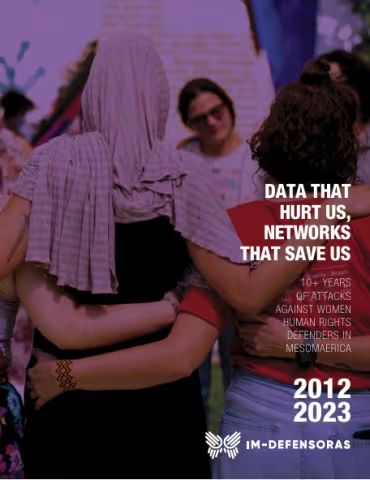
Over the last 10-plus years, the Mesoamerican Initiative of Women Human Rights Defenders (IM-Defensoras) has developed a system to register attacks1 that documents, quantifies, and allows us to conduct a gender analysis regarding the violence perpetrated against the diversity of women and sex-gender dissidences who defend human rights in Mesoamerica. The advantage of this system – a pioneer worldwide – is that, through its interaction with the other Feminist Holistic Protection strategies,2 it contributes to the protection of women defenders by identifying the types of violence and the concrete realities that we face, both individually and within our collectives. 

This report has two main content areas. It presents an analysis of the numerical data gathered by dozens of sister defenders who, starting from a close relationship and commitment with the territories, are responsible for the registry and documentation in each national network of women defenders, and who come together regionally in our Registry Strategy.3 Importantly, the report also includes a compilation of the reflections and analysis we have collectively built over these more than ten years.

Read the full report on IM-Defensoras' website here

Read the full report on IMD's website here.
Coming Soon: APC Research on the Digital Repression of Women Human Rights Defenders

What happens when digital spaces become tools of surveillance, censorship, and control? For women human rights defenders (WHRDs) in Brazil, Ecuador, India, the Philippines, Uganda and Tanzania, this is not a hypothetical, it’s a daily reality. 

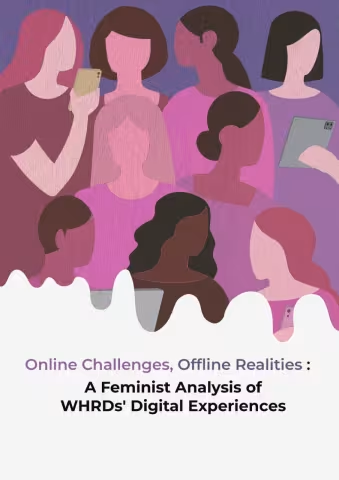
APC’s upcoming research, “Online Challenges, Offline Realities: A Feminist Analysis of WHRDs’ Digital Experiences,” explores how digital authoritarianism is accelerating across these six countries, and how WHRDs are targeted at the intersection of gender, power, and technology. From doxxing and smear campaigns to arrests and threats of violence, WHRDs face coordinated attacks aimed at silencing dissent and reinforcing patriarchal norms. 

This research draws from a feminist holistic protection framework to map how digital repression is deeply connected to offline violence, and how state and corporate actors are complicit. Surveillance laws, cybercrime regulations, content moderation failures, and extractive tech practices all converge to create hostile environments for WHRDs, particularly those from Indigenous, rural, and marginalised communities. 

Key insights from the research highlight how gender, sexuality, and race are weaponised in online attacks; how digital violence often escalates to physical threats; how legal systems are used to criminalise dissent, and how big tech and state surveillance tools facilitate unrestrained repression. This research emphasises on the need for gender-sensitive cybersecurity laws, urgent response systems, and platform accountability, especially from companies like Meta and Twitter. 

Despite escalating risks, WHRDs continue to resist, adapt, and organise. This research provides timely analysis for committing to feminist digital rights and holistic protection. 

Online Challenges, Offline Realities will be published soon as part of APC’s Safety for Voices Initiative. Stay tuned.

Coming Soon: APC's Anthology Narrates WHRDs’ Experiences of Violence and Resilience

"With tiny seeds in the broken grounds, we connect the future to our roots and breathe life towards the sky, unyielding in our shared manifestations, where the root, the trunk, and the flowers bloom as one. Online." – Kalkidan Tesfaye (Ethiopia) 

What does it mean to hold the line when the world demands your silence? 

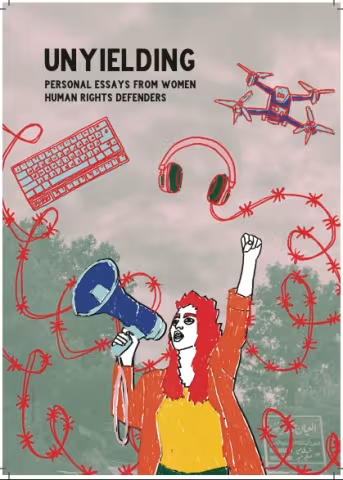
In this anthology, Unyielding – Personal Essays from WHRDs, women human rights defenders from across the Global Majority speak the unspeakable. They write from exile and ancestral lands, from underground networks and forgotten courtrooms, from the deep fatigue of burnout and the unrelenting will to keep going. 

This anthology, developed through APC’s Safety for Voices initiative, captures the stories rarely included in policy reports or human rights frameworks: the psychic cost of disinformation, the humiliation of body-shaming attacks, the pain of losing your homeland to war, and the injustice of being rendered voiceless unless you translate your trauma into Western palatable formats. 

The essays, spanning Syria, Ethiopia, Myanmar, Pakistan, and beyond, reveal the shifting forms of violence WHRDs face: surveillance and smear campaigns, political repression, legal persecution, displacement, and digital hate. Yet these stories also uncover what persists: the quiet power of community, the memory of justice movements, the longing for futures where dignity is non-negotiable. 

Here, vulnerability is not weakness, but a method of resistance. In Unyielding, these WHRDs narrate their own stories in their own terms, through reflection, rage, humour, and heartbreak, and insist that power must always be held to account.