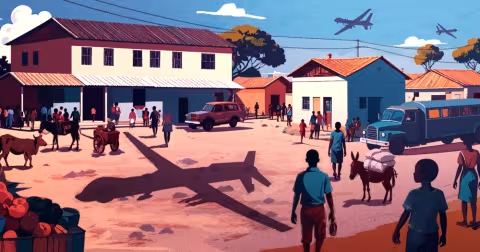
From women’s centres gone dark to mass displacement and starvation, the human toll of Sudan’s digital siege has been devastating and unreported—yet there is fierce determination from women on the ground to organize and stay connected.
In just two years, the violence unleashed by the Rapid Support Forces (RSF), a militia force that has violently occupied much of Sudan, has contributed to the deaths of more than 150,000 people across Sudan. The U.S. has accused the armed group of genocide. According to the Sudan Research Group, that death toll is mostly not from bombs and bullets, but from preventable diseases and starvation, because of the calculated destruction of infrastructure, communication networks, and services in the country. Since April 2023, the RSF deployed violence through ground assaults and aerial attacks but also through systematically cutting off vital internet and telecommunications infrastructure.
According to Internet Society Pulse and digital rights monitors, nationwide connectivity first collapsed to just 44% of normal levels in April 2023, coinciding with RSF attacks and occupations of key telecom hubs in Khartoum and other urban centre. The RSF’s militarized seizure of infrastructure, along with power cuts and fuel blockades, led to cascading blackouts. Between February 2 and May 13, 2024, a significant disruption occurred when major internet service providers Sudatel and MTN, holding 53% and 21% of the market share respectively, went completely offline. This blackout lasted for 101 days, leaving over 14 million people without internet access and hindering critical services like mobile banking and emergency communications. These disruptions totaled over 12,707 hours, equivalent to more than 529 days, exacerbating the humanitarian crisis by impeding aid delivery and isolating communities. These blackouts were not random—they were strategic tactics of warfare and control.
“Access to the internet and telecommunications isn’t a luxury. For us, it’s a matter of life and death. It’s how we protect our teams, reach our people, and carry out life-saving work,” said Mastora Bakhiet, a human rights defender and founder of Darfur Women Network, a grassroots organisation that runs a series of centre for displaced Sudanese women around Darfur.
Up until recently, her organisation ran the Darfur Women Community Center in Nyala, a city of 1.1 million in south-west Sudan. It was a vital space where they trained women in soap-making across four different IDP (internally displaced persons) camps. They were set to launch a new computer literacy programme in May. But then, this April, everything changed. The internet was cut off and they were forced to shut everything down. “This center wasn’t just a building—it was a source of economic empowerment for displaced women. And now, suddenly, we don’t know what’s happened to it. We don’t know who’s alive or dead. We can’t check on the center. We know it was looted, but it’s too dangerous to send anyone to find out more. We’ve lost all contact—not just with the space, but with the staff and women we were supporting.”
The same silence and fear now grips much of Darfur. On April 13, the RSF launched a brutal assault on Zamzam IDP camp, targeting one of the largest displacement camps in the region. What followed was a massacre—hundreds killed, including women and children, hundreds of thousands displaced, and a total communications blackout.
“In Zamzam, there’s currently no communication at all. It took four days to relocate part of our Zamzam team to El Fasher. Two team members were missing. Just yesterday, we learned that one of them was killed by the RSF in the Zamzam massacre. Osam, the other team member, is still missing. And Osam is just one of many. There are countless people missing. We don’t know where they are, or if they’re even alive.I’ve been personally devastated trying to get in touch with my family in Nyala. Not knowing if they’re safe keeps me up at night. I can’t sleep when I can’t reach my family, my friends, or my team members.”
Across Sudan, women-led organizing networks have borne the brunt of this coordination vacuum. In major cities such as Omdurman and El Fasher, youth-led and women-led neighbourhood resistance committees have scrambled to fill the gap left by national organisations and shuttered government services. These local groups rely on human messengers, bicycles, handwritten notes, and improvised community radio systems to keep people informed about airstrikes, RSF movements, and the location of safe houses or food stocks. The stakes are often life or death.
Before they began raining aerial bullets on villages, the RSF militia strategically seized control of Sudan’s communications infrastructure—cutting off access to information, suppressing resistance, and isolating civilians from the outside world. Entire regions were plunged into darkness. These blackouts made it nearly impossible for Sudanese women to coordinate, document atrocities, or seek urgent medical care and humanitarian aid. As Mastora Bakhiet explains, “the RSF posts videos on Facebook on how proud they are of destroying the city and the infrastructure. They are explicit about their destruction and targeting of civilians, particularly women and ethnic minorities.” This weaponization of digital repression is not incidental, it is part of a systematic campaign to terrorize and erase.
As Sudanese forces take back control from RSF, activists, defenders and community members have fought to stay connected, exposing the RSF’s brutal tactics and finding alternative ways to resist digital oppression.
How the RSF Seized Control of Sudan’s Telecommunications
The RSF’s stranglehold on Sudan’s telecom sector was not a byproduct of war—it followed a calculated premeditated strategy. Under the leadership of Mohammad “Hemedti” Hamdan Dagalo, the RSF began infiltrating Sudan’s economic landscape long before the militia’s armed takeover in April 2023. One of the most critical steps in consolidating power came when Hemedti and his partners acquired a controlling stake in Zain Sudan, the country’s largest telecommunications provider, in February 2022. This strategic acquisition enabled the RSF to manipulate and obstruct access to mobile and internet services with impunity.
As the RSF intensified its campaign of violent occupation and displacement through 2023 and 2024, Hemedti leveraged Zain’s infrastructure to throttle or outright shut down services in regions where it sought to suppress resistance or obscure human rights violations. By selectively restricting internet services in areas under their control, the RSF could operate with greater impunity—massacring and terrorizing civilians, displacing entire communities, and looting villages without leaving behind the digital traces that could prompt international outcry or intervention.
Determined to dominate the digital landscape, the RSF went after rival companies as well. Among the key targets were Sudatel and MTN Sudan, some of Sudan’s few remaining independent telecom providers. The RSF launched a coordinated campaign to sabotage all remaining telecommunications infrastructure- destroying satellite uplinks, fiber-optic hubs, and relay towers in a matter of weeks.
On February 4, 2024, RSF personnel raided the main facilities of Sudan's primary telecommunications companies Sudatel and MTN Sudan, effectively plunging vast regions of Sudan into a communications blackout. At gunpoint, they ordered engineers to sever all communications and internet services nationwide. By early 2024, large swaths of Sudan—particularly in Darfur, Kordofan, and parts of Khartoum—were plunged into near-total digital silence. With Sudatel incapacitated and Zain under RSF influence, millions of Sudanese people were cut off from their families, the media, and the outside world. This recent round of blackouts has been one of the most devastating, leaving entire cities without access to emergency services, news, or basic digital communication.
This blackout wasn’t just a technological inconvenience; it was a humanitarian catastrophe. Civilians lost the ability to contact loved ones or seek help during attacks. Entire cities and villages were cut off from emergency services. Hospitals couldn’t order medical supplies. Families couldn’t check on displaced relatives. News stopped flowing.
Adam Rojal, a humanitarian worker from Darfur who is currently a volunteer at the Nertiti IDP camp, witnessed the fallout firsthand. “I lost my job because I worked online with humanitarian organisations abroad,” Rojal said. “I can’t report on the horrific violence happening here. I can’t check on my family. There is no way to know who is alive or dead.” His voice cracks as he describes entire villages that have vanished from the digital map, with no way to verify their fate. His experience underscores how digital blackouts can become tools of erasure, rendering atrocities invisible and survivors unreachable.
Weaponizing Starlink: RSF’s Private Communications Network
While the RSF has aggressively dismantled Sudan’s public telecommunications system, it has simultaneously built a private, secure communications network powered by Starlink—a satellite internet service operated by Elon Musk’s SpaceX. The introduction of Starlink has proven to be a double-edged sword in Sudan: while it offers high-speed, decentralized internet access theoretically outside the reach of traditional ISPs, in practice it has been monopolised by the RSF. The militia has deployed Starlink terminals across all active battlefronts, making the system a critical component of its military operations. These terminals provide real-time, high-speed internet access for RSF commanders, enabling coordinated attacks, drone operations, and intelligence gathering.
The RSF’s use of Starlink has significantly enhanced its battlefield capabilities, allowing uninterrupted communication even in remote areas where traditional networks have been destroyed. According to reports, RSF units use Starlink to operate surveillance drones and execute precision strikes, making it an essential tool for their military strategy.
Meanwhile, the Sudanese population remains largely cut off, as civilians are unable to access or afford satellite-based alternatives. In many regions under RSF control, the only way civilians are able to get in touch with the outside world is by renting Starlink services directly from RSF militia-men. This process is dangerous, only accessible to men, and, if successful, men must pay exorbitant “usage fee” rates. Bloomberg reports that RSF Starlink dealers charge around a month’s salary for only one hour of internet. Those who can afford this amount risk violence from contact with the militia.
An anonymous mother currently living in an RSF-occupied zone recounts the horrors she experienced when she and her son approached an RSF-controlled Starlink terminal, attempting to purchase Starlink internet coverage from the militia; “My son is mentally disabled and when he wouldn’t answer them, they shot him in the leg then took him from me. They said they were arresting him then robbed me of my belongings. After two weeks they dropped him off at our home, starving and in need of desperate medical attention.”
The dual strategy of destruction and technological adaptation has given the RSF a monopoly on telecommunications, reinforcing its ability to suppress opposition while maintaining private infrastructure for its own forces. The monopolization of digital tools like Starlink not only enhances the RSF's operational capacity but further isolates Women Human Rights Defenders (WHRDs), cutting them off from international protection mechanisms and emergency networks. Activist groups have called on the international community to address this growing concern by ensuring that private satellite networks do not become tools of oppression and war. Aid groups on the ground face similar challenges.
The human cost of the digital siege
The consequences of the RSF’s control over communications extend far beyond lost phone signals or Wi-Fi. For many, it has meant the loss of life, safety, and livelihood. Internet shutdowns have created significant challenges. With limited or nonexistent connectivity, coordinating relief efforts has become incredibly difficult, slowing down the distribution of aid and the organisation of resources. Critical information cannot be shared effectively during these blackouts, leaving aid groups, community kitchens and emergency response rooms struggling to keep their teams and the communities they serve informed. With coordination channels severed, international and local humanitarian organisations struggle to deploy resources where they’re most needed. Medical supply lines are disrupted, food distribution delayed, and emergency evacuations thwarted by the inability to communicate. In some regions, aid convoys have had to rely on word-of-mouth messengers or couriers traveling by foot—a method fraught with danger and inefficiency.
The communications blackout has also placed Sudanese women journalists at heightened risk. Since the RSF siege, amongst those killed while covering conflict were two iconic women reporters—Halima Idris Salim and Samaher Abdelshafee— one fatally run over by an RSF vehicle in Omdurman, the other killed during a shelling attack on a displacement camp in Central Darfur. Others have faced physical assault, sexual violence, and targeted harassment, forcing some into exile. The Sudanese Journalists Syndicate has reported a surge in violence against female journalists and responded by launching a national hotline to provide support to those still operating in conflict zones.
How the RSF Uses Blackouts as a Weapon
The RSF’s strategic use of telecommunications blackouts serves multiple interconnected goals. First, it suppresses evidence of war crimes. In today’s world, smartphones are often the most powerful tools for documentation. Without internet access, victims and witnesses cannot upload videos, send voice notes, or communicate with journalists. Massacres, forced displacement, sexual violence, and torture go unreported, and the perpetrators remain unaccountable.
Moreover, the RSF seeks to control the narrative. With media outlets shuttered and journalists fleeing or silenced, the militia has a near-monopoly over the information that leaves Sudan. They push propaganda via social media channels run from abroad, releasing curated images and statements that obscure their role in war crimes and paint them as liberators or defenders. In the absence of counter-narratives from affected communities, many international observers are left with a distorted understanding of the conflict.
Importantly, cutting off communication disrupts humanitarian coordination. Humanitarian groups depend on real-time data to deliver aid, track displacement, and assess needs. When internet and mobile networks are down, supply chains break down too. Emergency response times stretch from hours to days. Communities that are already vulnerable become even more isolated, with no way to alert the outside world about food shortages, disease outbreaks, or imminent attacks.
Sara, a student activist from Darfur, vividly recalls how blackouts disrupted her life and education. Whilst studying medicine at the University of Medical Services and Technology in Khartoum, she recalls the effects the blackouts had on her education, “Sudden blackouts and internet shutdowns prevented my class from taking midterm exams,” she said. “There was no internet, no way to contact the outside world. Blackouts would go on for weeks or months at a time. When the blackouts happen, it's really scary,” she said., “Phone lines were cut. We just had to stay in our homes and rely on neighbours for updates.”
How WHRDS, Activists and Organizers Are Fighting Back
Despite these oppressive tactics, Sudanese activists have not remained silent. Instead, they have turned to an array of alternative tools and organizing methods to sustain their resistance.
Local organizers and neighbourhood resistance committees have borne the brunt of the coordination vacuum. In places like Omdurman and El Fasher, youth-led networks have scrambled to fill the gap left by national organisations and government services. These local groups rely on messengers, bicycles, handwritten notes, and improvised community radio systems to keep people informed about airstrikes, RSF movements, and the location of safe houses or food stocks. The stakes are often life or death. These decentralized networks have become the backbone of grassroots resistance and survival.
One of the most innovative solutions has been the use of offline messaging apps such as Briar and Bridgefy. These platforms operate over Bluetooth and mesh networking, allowing users to send messages without relying on cell towers or Wi-Fi. Used in tandem with e-SIM technology, they have enabled limited but vital communication between activists in blackout zones. These tools have been critical for coordinating local defense efforts, tracking militia movements, and issuing safety alerts.
In areas where Starlink access is available but monopolised by the RSF, some activists have found discreet ways to access the service—sometimes with the help of sympathetic outsiders or through smuggled equipment. Though highly risky, these efforts have allowed urgent reports to reach the diaspora and the international press.
Where digital tools fall short, Sudanese communities have revived traditional modes of communication. Radio broadcasts have resurfaced as lifelines in areas where mobile phones are useless. Community leaders have formed messenger networks, often relying on trusted individuals to relay updates from town to town. These analog strategies, while slower, are more resilient in the face of digital sabotage.
Sudanese diaspora networks also play a pivotal role. With access to stable internet and international platforms, diaspora activists amplify the voices of those on the ground. They translate testimonies, publish reports, organize protests, and lobby foreign governments. Their work ensures that Sudan’s blackout doesn’t become a blackout of conscience abroad.
Diaspora communities have also collaborated with technologists to explore low-cost, portable satellite communication alternatives and the deployment of solar-powered mobile towers in areas outside RSF control. Though limited in scope, these pilot projects represent an evolving effort to reclaim digital autonomy and support self-determination through innovation.
A Battle for Connection and Survival
The RSF’s telecommunications offensive is not just about silencing dissent; it is about erasing lives. By destroying infrastructure, monopolizing internet access, and weaponizing technology, the militia has turned Sudan’s digital space into a battlefield. Yet even in the face of this overwhelming repression, Sudanese people continue to resist. From refugee camps to diaspora communities, the fight to stay connected remains at the heart of the struggle for justice, dignity, and self-determination.For Sudanese WHRDS, maintaining digital connectivity is not merely about communication, it is central to resisting erasure, documenting violations, and sustaining movements for justice.
The battle for Sudan’s future has profound global implications. It reveals how modern warfare increasingly plays out in cyberspace as much as on land. It also calls upon the world to recognize digital access as a human right—a lifeline in times of crisis.
Despite the RSF’s extreme efforts to silence news flow within Sudan, information is still being collected, organized, and disseminated to report what’s really happening, showing Sudanese voices can not be erased.