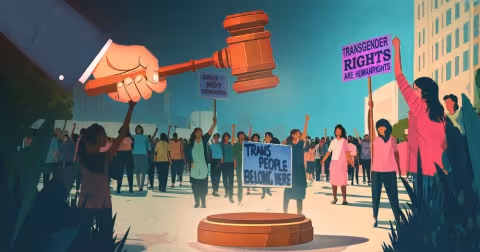
A community once linked to saints is being violently attacked locally with language and tech borrowed from U.S. anti-trans activists.
Maliha, a trans man, was threatened with being outed to his family by a cis woman in Karachi, Pakistan. This threat triggered panic attacks and led him to temporarily deactivate his social media accounts.
Maliha sought mental health support, but feared that professionals might out him. His extended family, already suspicious of his gender identity, frequently repeated anti-trans talking points. After months of receiving anti-trans content from cousins, he admitted, “I now have a lot of self-doubt about whether my transness is valid.” That self-doubt, he explained, has made him feel the need not only to prove his identity to others, but also to himself.
One recurring theme Maliha noticed in conversations with family and colleagues was their reference to Donald Trump’s statement that “there are only two genders, male and female.” To them, this was proof that “even the American government is recognising its own mistakes”, a supposed vindication of their anti-trans beliefs. After years of searching, Maliha has found a supportive therapist with whom he is working through the trauma of his transness being repeatedly invalidated.
As Pakistan’s trans rights defenders come under attack, what’s increasingly clear is that they are being targeted not just by hate, but by technologies of war repurposed for domestic repression. From digital surveillance and doxxing to psychological warfare tactics like social media humiliation, these strategies mirror the logic of counterinsurgency: aimed not merely at silencing dissent, but dismantling the safety, dignity, and very identities of those most vulnerable. For trans and nonbinary defenders, these tools are not abstract; they are lived threats that corrode mental health, isolate community, and endanger lives.
Anti‑trans panic in Pakistan
In August 2022, amidst political unrest and a worsening cost-of-living crisis, Pakistani influencers launched an anti-trans moral panic. They borrowed language from U.S. Republican rhetoric around “gender ideology” and combined it with religious nationalism, framing the existence of Pakistan’s ancient trans community as a “Western-funded agenda” meant to destroy the country’s “family system.” Globally, this language is often used to portray trans and gender-nonconforming people as threats to a so-called “natural” social order.
In Pakistan, influencers are targeting the centuries-old Khawaja Sira community (historically referred to as hijra), and accusing them of being a foreign import despite their deep roots in South Asian history and spiritual traditions. A community once linked to saints has been recast as “mentally ill” with language borrowed from U.S. anti-trans activists. This is causing a barrage of local online and offline violence against Pakistan’s trans community. But trans rights defenders are organising and fighting back.
Though attacks on Khawaja Siras are not new — the British colonial government criminalized the community in the 19th century — what’s changed is the narrative. Anti-trans influencers began citing U.S. news reports and the Biden administration’s support for trans rights as proof that Pakistani trans identities were part of a Western conspiracy. When Trump declared “there are only two genders,” some influencers celebrated, with one podcast gloating, “Bye Bye Gender Ideology.”
In September 2022, a senator from a religious party falsely claimed that nearly thirty thousand Pakistanis had changed their gender markers under the 2018 Transgender Rights Act. Calling this a “Western cultural invasion,” he appealed to “social media activists, YouTubers, and Islam-loving young people” to upload a million videos against the law. This call to arms became a loyalty test: opposing the Transgender Rights Act was equated with being a pious Pakistani Muslim. What followed was a misinformation-driven frenzy, shaped by U.S.-style transphobia, but cloaked in Pakistani Islamic nationalism.
The panic first focused on rolling back trans legal recognition, citing false claims such as the legalisation of gay marriage. Eventually, the Federal Shariat Court struck down gender self-identification as un-Islamic in May 2023, although the judgment is currently under appeal to the Supreme Court. The campaign then shifted toward embedding transphobia in daily life: targeting women’s spaces, children’s education, and talk shows. Influencers wove anti-trans rhetoric into lifestyle content for middle-class mothers on Instagram, normalizing hate within everyday content.
Making transphobia trend
In 2022, with rising inflation and political instability, Pakistan’s urban middle class faced growing anxiety about their futures. Anti-trans influencers capitalized on these fears, packaging transphobia as a marker of elite status.
A fashion designer promoted anti-trans views while wearing her own label. A religious podcast criticizing trans people was branded with luxury motorbike imagery. These stylized expressions of hate, wrapped in high-status aesthetics, reinforced traditional gender roles. Men were shown riding expensive bikes through mountains; women, dressed in designer clothing, were told that hating trans people was how they protect their children and Islamic values. This mix of English phrases, luxury branding, and traditionalist values turned transphobia into a lifestyle choice marketed to a disaffected urban audience.
Mehloob*, a trans woman who spent nearly a decade as a trans rights defender, carefully maintained a low profile. Watching the wave of online hate grow, she observed that anti-trans bullies don’t rely on medical evidence, they target anyone whose appearance or voice doesn't conform to idealized gender norms. This includes cis women with short hair, deep voices, or athletic builds. Pakistani trolls, like their U.S. counterparts, began conducting “transvestigations”: analyzing photos or videos to “prove” someone is secretly trans. Even high-profile figures like protest leader Mahrang Baloch and actor Momina Iqbal were targeted.
Mehloob* and other names mentioned with a * have been changed to protect the safety and privacy of the source.
In his 2018 essay The Cruelty Is the Point: The Past, Present, and Future of Trump's America, Adam Serwer said that “Their shared laughter at the suffering of others is an adhesive that binds them to one another, and to Trump… community is built by rejoicing in the anguish of those they see as unlike them, who have found in their shared cruelty an answer to the loneliness and atomization of modern life.”
Serwer’s words apply equally well to the context of anti-trans rhetoric imported into Pakistan. For example, when murders of trans women are reported online, it is all-too-common for Pakistani commenters to celebrate it as a good thing for the country. It is not the death of a trans woman, but the violence that killed her that online trolls celebrate.
Many smaller troll accounts simulated anti-trans violence or openly talked about their desire to bully trans women, often accompanying viral hashtags denying the validity of transness. However, in one video a prominent leader of the anti-trans movement pointed to an Aurat (Women’s) March poster showing a trans woman and called trans people an “agenda” that deserved “humiliation”. Comments praised the influencer’s “bravery” for “protecting Islamic values,” illustrating how cruelty is rewarded with social capital.
It has not mattered whether anti-trans influencers sneered, openly mocked or humiliated trans people, they have been praised for expressing anti-trans views. With transphobia increasingly being associated with higher social status in Pakistan, online attacks on trans people also increased. Initially replicating Trump or MAGA language calling for “eradication of transgenderism,” some Pakistani anti-trans influencers have even called for trans people to be killed.
Apps and platforms, once designed for connection, are now surveillance tools. Anti-trans actors exploit metadata, and the reach of viral content to stalk, shame, and silence. These are the tools of a digital war: not against an enemy combatant, but against people asserting their right to exist. In this war, trans activists are rendered both hyper-visible and intensely vulnerable, their every word, photo, or friendship is a potential weapon against them.
Doxxing, threats, and public shaming
Invalidating hashtags also accompanied before and after photos of trans women activists who had transitioned. Similar to an anti-trans troll tactic in the United States, “before” photos were held up as “evidence” of the “deception” of trans women, who (according to anti-trans trolls) were “men pretending to be women” to “invade women’s spaces.” Sometimes trolls deadname the trans activists, i.e. called them by the pre-transition names they no longer use, as an additional way to invalidate their transness.
Constant online harassment, hateful messages, and threats create an added mental health burden for marginalized groups known as minority stress. This extra strain, caused by discrimination and stigma, compounds existing struggles, wearing down resilience over time. For trans women and others who do not conform to idealized beauty standards, the relentless attacks do not just hurt in the moment. They deepen self-doubt, worsen symptoms of anxiety and depression, and reinforce a sense of being unwanted.
These tactics function as gendered weapons in an information war. Algorithmic amplification of hate is now mobilized against trans rights defenders by troll networks. Just as wartime psy-ops aim to disorient and demoralize, the goal here is not just visibility of anti-trans narratives, it is control, humiliation, and erasure of trans people.
Zara, a trans content creator with thousands of Instagram followers, was doxxed after beginning to live openly as a trans woman. Her schoolmates shared her pre-transition photos on WhatsApp, calling her existence an “abomination.” Though she tried to defuse the hate with humor, the bullying didn’t stop. She performed on social media using an alter ego of ambiguous gender. So long as she performed using a caricature, it offered an element of safety, as it was only when she started living openly as a trans woman that she was doxxed, i.e. her private details were leaked, endangering her safety. She eventually reduced her public presence and stopped posting content as her alter ego.
Mariam* limited her online presence after observing fellow trans women being villainized and fetishized online. She worries about the safety of fellow trans women who are more visible. She hides her face in certain public gatherings out of fear of her photos being leaked online. Mariam laments security concerns limiting her ability to share her moments of joy and celebration online. This makes her feel less connected to community and friends.
Arzu, a trans rights defender, reports increased instances of cyber harassment and digital extortion in Khyber Pakhtunkhwa province, one of the most dangerous regions in Pakistan for trans people. These include instances of extortion gangs creating fake profiles using stolen photos as well as non-consensual pornography. Similarly, one troll tactic across the country is to create group chats to coordinate threats of violence and coordinate uncovering trans activists’ personal information.
Trans rights defender Bubbles, having experienced online bullying from both men and women, describes “years of countless anxiety attacks, not knowing if I was safe when leaving my house.” Bubbles’ experience mirrors an increasingly hostile digital environment where platforms like Instagram and X prioritize engagement over safety, which results in failures to curb coordinated attacks, leaving activists vulnerable. Even before the recent content moderation rollbacks announced by Meta and X in early 2025, using the platforms’ reporting features did not result in the removal of anti-trans content in most cases. This was even more so the case when the content was in Pakistani languages.
Like Maliha, Bubbles has been wracked with self-doubt. While she knows the importance of her advocacy, the words of trolls torture her thoughts: tone it down, be less outspoken, be less visible. She finds herself “desensitized” to threats after receiving them for 4 years but acknowledges that “not everyone is able to deal with it in the same way.” Despite years of anxiety from relentless threats, Bubbles continues her digital and offline activism.
Zanaya, a trans rights activist, was followed and nearly assaulted after giving a TV interview. She received blackmail threats warning her not to go to the police. Then a second attempt was made to assault her. She described fear and hypervigilance about being followed, leading to her temporarily reducing her public engagements. Despite the trauma, she later joined the Punjab Police as a Victim Support Officer for trans people, after offering volunteer guidance when the department began setting up facilitation centres for vulnerable populations in 2023.
Survival amongst inadequate mental health support
Pakistan’s mental health infrastructure is deeply lacking. Many professionals are untrained in working with marginalized populations and some actively engage in conversion therapy, a practice proven to be harmful and ineffective. One young trans woman was forcibly institutionalized in a “rehab centre,” where licensed professionals used violence in an attempt to “cure” her. Her story circulated online, until she was forced to take the videos down.
Even professionals who call themselves “trans-friendly” often fail to provide clear, informed practices, creating mistrust among trans people. As a result, trans people are forced to be creative. Many turn to peer support systems: informal conversations with friends, peer-led mental health groups, and community spaces that offer more empathy than formal care. However, this burden is heavy. Many trans people remain silent, afraid their mental health struggles could be weaponized in intra-community politics.
Minority stress takes both tangible and intangible forms: ranging from direct threats to the daily emotional toll of seeing one’s existence framed as a political “debate” or “ideology.” Even when trans people reduce their visibility to avoid immediate danger, the psychological impact of living in a hostile environment lingers. Depression, anxiety, and PTSD are common. Affirming care, both socially and medically, has been proven to improve mental health outcomes. But such care remains scarce.
These are the effects of psychological warfare. When defenders cannot trust health providers, fear being digitally tracked, or experience threats, the line between social repression and personal trauma blurs. The war on trans rights is no longer metaphorical, it uses the same architecture of control: coercion, fragmentation, and targeted destabilization of emotional well-being.
While the imported anti-trans panic continues to wreak havoc in Pakistan, we cannot remain passive observers. We must 1) demand social media companies implement proper content moderation to stop anti-trans bullying and harassment, and 2) support trauma-informed trans mental healthcare that rejects traumatising conversion efforts. Share resources, contact policymakers, and amplify trans-led solutions.