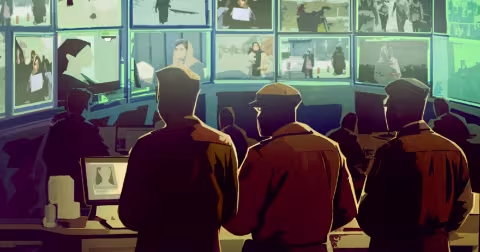
DEK: In one of the world’s most densely militarised zones, surveillance is not just omnipresent, but is forcefully outsourced to its very own residents—deepening gendered repression and placing women defenders under a digital microscope.
Salman* was updating his shop’s inventory, as he did every morning, when he was summoned at a police station in Srinagar, the capital city of Indian-administered Jammu & Kashmir. There, dozens of other small business owners were ordered by the station’s police chief to install CCTV cameras outside their shops in April 2023. Crime has been rising since 2019, they were told, and this was for their safety and their businesses’ security. When Salman and others weren’t convinced, the police chief’s tone changed.
A CCTV system for a business establishment costs upwards of INR 30,000 ($344) in local stores, excluding the cost of power backup systems, which they would need since authorities had ordered 24/7 surveillance.
“He told us that they would beat us up if we didn’t follow orders,” Salman said. Eventually, the traders were given a concession: They could pool in money and install a common CCTV system. After the mass summon, Salman said, policemen routinely visited markets to inspect installations and adjusted camera angles towards roads instead of the shops. If they questioned the cops, they faced abuse.
Salman, and other Kashmiris interviewed in this piece marked with an *, are identified with pseudonyms to protect them from reprisals from authorities.
Although formal orders issued by the bureaucratic administration lay down criteria for data retention for up to 30 days, Salman said they were anxious. “What if we don’t have the footage they need [from a month ago]? They will just break our backs,” Salman said.
In Kashmir, the monitoring of public posts alone has led to several detentions and arrests in recent years, mostly under vaguely drafted and open-ended provisions such as the Public Safety Act and Unlawful Activities (Prevention) Act.
Mir Urfi, a woman human rights lawyer in Srinagar, is one of few Kashmiri lawyers willing to represent those accused under India’s stringent Unlawful Activities (Prevention) Act, a majority of whom are from India’s only Muslim majority state.
She said the creation of the surveillance state is justified by classifying Kashmir as a “disturbed area,” adding that the police begin their investigations by collecting digital evidence, mainly cell phone locations, and CCTV footage collected from shopkeepers like Salman.
The outsourcing of surveillance—including its cost—to civilians isn’t legal, Urfi, the human rights defender and lawyer said, but Kashmiris have no choice. “Civilians can move the courts, but people don’t do so because at the end of the day, they again have to face the police, and there is an environment of fear created by the police. Our right to exist is at stake, so things like privacy don’t matter so much to the people,” she said. “ Survival takes priority.”
For women human rights defenders in Kashmir, technologies of war—particularly digital surveillance—have been re-engineered to operate as intimate tools of intimidation. Not only are their public actions monitored, but their private lives are dissected under the state’s algorithmic gaze.
Digital surveillance has been a part of Indian Prime Minister Narendra Modi’s nationwide programme called Digital India since 2015. The scheme, aimed at turning the world’s most populous country tech-savvy and crime-proof, is reminiscent of 19th-century colonial playbook, which has since evolved from targeted surveillance to mass surveillance. Under Modi, India became the world’s second-most surveilled country, with over 1.5 million CCTV cameras in 15 cities, according to UK-based cybersecurity and privacy research firm, Comparitech. There is no statistical correlation between CCTV cameras and crime reduction.
Vasundhara Sirnate, an Indian political scientist and journalist whose work looks into surveillance across India’s conflict zones, calls the security apparatus in Kashmir an “architecture of oppression.” Surveillance here is layered, she said, and is a mix of physical surveillance and digital surveillance. Apart from CCTV cameras and phone tapping, the digital panopticon gets more granular each year as online spaces are heavily policed. “The surveillance network has entered people’s homes,” Sirnate said, “which exacerbates the level of distrust that’s already deep-seated in the region because there’s a constant sense of being watched.”
In Kashmir, digital surveillance has little to do with crime. The region has been a flashpoint between nuclear-armed India and Pakistan since 1947. The two countries fought two wars for full claim, but control parts of it. China too controls a portion of the territory in the east.
India deploys an estimated half a million soldiers here – with the number reinforced by up to a million more in times of need – making Kashmir one of the world’s most densely militarised zones. Surveillance is interspersed with not just India’s security measures but also a history of armed resistance. Clashes between Indian security units and militants have claimed tens of thousands of lives, mostly civilians. Human rights watchdogs have documented violations by Indian security agencies such as enforced disappearances and torture. In 2019, India revoked Kashmir’s semi-autonomous status, downgraded it to a union territory and brought it under federal rule until October 2024. There has been nominal local representation since then, but the federal government continues to control the police and armed forces deployed here. In the meantime, violence continues, as does the intensification of India’s militarised infrastructure, of which surveillance – both physical and digital – is a key part.
Salman’s experience speaks to the distinct nature of surveillance in Kashmir. In a landscape dotted with security personnel, the Jammu and Kashmir Police reportedly installed over 1,000 CCTV cameras since 2010 citing infrastructure boost and safety. In 2022, orders mandating business owners to install CCTV cameras added a dimension of enforced communal surveillance that gives civilians no option but to become active members of the surveillance state, in which they have barely any say or representation. Indian security agencies, which operate in the grey area between law and national interests, prioritise “interests of the state” over fundamental rights.
“The ultimate aim of this surveillance is, no doubt, control,” said Srinivas Kodali, a hactivist and researcher who advocates for transparency on technological systems. “The kind of control that dictates [surveillance], right now, is a Hindu majoritarian order.” Kashmir is the most populous Muslim-majority territory in Hindu-majority India, where the rapid rise of Hindu nationalism
dictates even national security. “There are fundamental rights assigned to mainland Indians – like the freedom to access information, or to move – but not to Kashmiris, thereby converting them from citizens with rights, to controlled beings who are subjects,” said Kodali.
The making of India's omniscient watchtower
The story of India’s surveillance systems, estimated to be a $2.5 billion industry, goes parallel to the rapid rise in penetration of internet and smartphones in the country. India’s digital economy is growing at twice the rate of its overall economy, said a report by the Prosus Centre for Internet and Digital Economy. The country is home to the world’s second-largest digital population, estimated to be 806 million active digital users, as of February 2025.
But India’s digital success comes with draconian control over its access, use and privacy, especially for the 12 million residents of Jammu & Kashmir.
Ninety-seven percent of Kashmiri households have a phone, according to the Netherlands-based Global Data Lab, while 58.8 percent of them have internet access. About a decade ago, the penetration of mobile phones and internet here was already higher than the national average. Moreover, the region’s close-knit societies and still-existing communal spaces ensure organic spread of information through word of mouth.
But, unlike the rest of the country, Kashmir’s digital spaces are deemed by the Indian government as a breeding ground for terror, misinformation, and secessionism. Restrictions on 4G or social media apps are common. In 2019, India imposed the world’s longest internet shutdown – lasting 552 days – in Kashmir, adding to the region’s count of a total of at least 849 internet shutdowns since 2012, the highest in the country.
Technological surveillance came into prominence in Kashmir after New Delhi allowed mobile phone services in the region. While mobile telecommunication was launched in India in 1996, it was disallowed in Kashmir until 2003 citing the Indian Army’s apprehension of its use by militants. As technology improved, New Delhi sought to increase mobile tower density in the region to track militants. Government forces have questionably free access to tower dumps and detailed phone records of citizens.
By the late 2000s, social media was dominated by politically-charged youth and the use of encrypted messaging apps prompted authoritarian intrusions into cyberspace.
Threat to life arising out of forced surveillance isn’t new. In 2015, militants began a campaign against telecommunication towers, killing at least two civilian landlords on whose properties the towers were established. Within a short span, more than a third of Kashmir’s mobile towers, particularly in the northern districts, were taken off the grid. The campaign was a bid by militants to escape surveillance.
Still, the situation is a double-edged sword for Kashmiris caught in the crossfire. The forced conscription into the state surveillance project has made civilians vulnerable to harm from any side – government forces or militants – whose wrongdoing, if caught on their cameras, makes them liable to be presented as witnesses in court. “In a conflict zone, it is easy to brand anyone as a militant or an informer, and both sides get an easy justification to target civilians—militants can kill someone accused of being an informer and [government forces] will kill who they think is a militant,” Urfi said.
The surveillance database includes the police survey, which was conducted door to door and also enforced upon mosques across Kashmir last year. The survey included questions ranging from phone numbers, vehicle numbers, possible links to militants and record of overseas travel, to the number of CCTV cameras installed at home. The year before that, the municipal corporations in Srinagar and Jammu created GIS-based surveys of all households by assigning QR-coded Digital Door Numbers to facilitate civic programmes. Geo-tagging homes is a part of Modi’s Smart City project and is embraced by a majority of Indians outside Kashmir. For Kashmiris, these initiatives, carried out to “systemise” citizens’ records, tie in with the surveillance, intimidation, and profiling of the residents.
“Surveillance doesn’t just criminalize and control bodies and information in Kashmir, but is also connected with a history of psychological warfare against Kashmiris,” said Saiba Varma, the Associate Professor of Psychological/Medical Anthropology at the University of California San Diego and author of The Occupied Clinic: Militarism and Care in Kashmir. “Kashmiris know this isn’t an ordinary conflict. It’s a war on their psyches, on what they’re supposed to think, not think or might think in the future.”
There is no official record of the scale of digital surveillance on civilians in Kashmir, except press trips organized by the Indian Army to showcase border surveillance, or the Jammu and Kashmir Police speaking to the press about using tools such as the Internet Protocol Detail Records.
“I don’t think anybody knows [the scale of surveillance in Kashmir] because they’re all black ops at the end of the day,” said Kodali.
Meanwhile, the awareness of surveillance in the region – and people’s own assumptions about the extent of it – has created a deafening, self-censoring environment.
Kashmiris navigate occupation and infiltration on social media
In 2020, Showkat* was summoned to the cyber police station for posting about an extrajudicial killings of three young men that year in Kashmir’s Shopian district by the Indian Army. The killings were passed off by the Indian Army as an “encounter” or gunfight with “terrorists” but was later proved to be false.
“Before 2020, I, like any other Kashmiri, used to post about every issue in my region,” they said. That day, they were summoned – without warrants – by security officials who read out their tweets and asked them about their “ideology,” family background, and education. They were let go and told not to post “political matters.” Showkat notes that their case was a part of a “mass social media crackdown” that year. Today, they add, most Kashmiris don’t use their real identities – or post news – online for fear of being tracked and summoned.
Social media monitoring has become a common feature of Kashmir’s security measures. It trickles down to checkpoints, too, where military personnel order people to hand over their smartphones and PIN to check photo galleries, social media accounts, chats and recently-deleted apps. Use of open source apps such as Telegram and Signal evoke suspicions and interrogation.
Showkat claims that an Indian Army official once installed an unknown app onto their phone during a cordon-and-search operation, a once-discontinued feature of Indian Army’s “anti-terror” operations, in an attempt to monitor their phone. “Indian Army officers also add their numbers on peoples’ phones, through which they send directives to upload pro-Army and nationalist photos and messages on their online status,” Showkat said. There’s already an official order that manages the social media presence of Kashmiri government employees. A covert operation to take over civilians’ social media accounts hasn’t been reported by news outlets or admitted by security officials.
Showkat adds that social media platforms now elicit deep fear among people. “Everyone operates on the assumption that there’s some kind of infiltration,” they said.
For human rights defenders and journalists, the control is more pronounced.
Silencing women journalists and human rights defenders
K*, a senior Kashmiri journalist, said security officials use journalists’ digital presence to dissect private lives, from everyday movements to information on their families, during summons. This often means endangering sources or personal privacy. At least 13 Kashmiri journalists have been detained since 2019 – a quarter of all journalists imprisoned in India, as tracked by Reporters Without Borders – under charges of terrorism, including for social media posts such as videos of protests.
“It’s a project of silencing, this digital monitoring of the public,” K said. The Jammu and Kashmir police maintains a well-equipped social media monitoring centre, manned by dozens, in its CID headquarters in Srinagar. “Even likes and comments are monitored. The digital space in Kashmir is as occupied [by soldiers] as the physical space.”
P* said women journalists are especially forced to keep their profile low because the intimidation uses their gender identity to silence them. “Once, security officials entered my neighbourhood and started asking around about me. In a small community, people start to wonder what I’ve done wrong. Security officials treat people of my gender as if it’s a weak spot to shut us down,” P said.
B*, a woman human rights defender, attests to this experience and said that she self-censors whenever she feels the urge to speak up because of the consequences it would have for people related to her. I couldn’t bear the thought of my family being harassed or questioned for it. For B, the surveillance came in the form of targeted harassment after she published a report on human rights in 2023. Soon after, she was inundated with phone calls from unknown numbers, often officials, asking “bizarre and intrusive questions.” “After repeated 10-20 calls a day, I switched off my phone for three months,” she said. “Every time I would turn it back on , the tirade of calls would continue. Eventually, I was forced to leave Kashmir.”
Digital surveillance also acts as a character certificate based on social media activities, journalism or work on human rights, which makes its way into the files of the CID. There, Kashmiris’ fates are decided: Whether they’re allowed to fly out of India, or fly in.
Many Kashmiris now hide behind VPNs while accessing social media platforms as security officials crack down on what they deem “false and malicious” posts. Big Tech platforms, too, have complied to shut down vocal Kashmiris. Apart from removing hundreds of thousands of Kashmir-related posts – including SOS messages – tech platforms actively collaborated with police by giving them access to IP addresses. In recent years, news outlets reported on tech platforms’ collusion in enabling alleged pro-Indian Army disinformation campaigns and targeting of Kashmiri journalists.
The press censorship is exacerbated by internet shutdowns, forcing Kashmiris to use government facilities to communicate during 2019, or adhere to government or police narratives to protect themselves. Anuradha Bhasin, who runs 70-year-old Kashmir Times, one of Kashmir’s oldest English-language newspapers, said surveillance of journalists existed in the 1950s too when her father started the newspaper. “Things worsened during the 1990s when both the state and non-state actors used guns to create fear. But the fear still wasn’t deeply embedded,” she said. “But when the intimidation enters the digital space, its hidden nature amplifies the fear.” Bhasin faced closure of her office in 2020. Now based in the US, the journalist is working to revive 20 years worth of Kashmir Times’ editions, which, she said, mysteriously disappeared online in 2021.
“Surveillance as a tactic has yielded huge dividends for the state. The flow of information [from journalists] has significantly dried up,” said K. “For us, it's a significantly disabling scenario: When you have full information but no attribution, it goes unreported. Our work, reported after due diligence, remains only for the sake of the record. This gives the government full narrative control.”
Trauma from chronic surveillance
A 2015 mental health survey conducted by Médecins Sans Frontières and Kashmir University, revealed that nearly 45 percent of Kashmiri adults – nearly 1.8 million – show symptoms of depression, anxiety and PTSD. “On average, an adult living in the Kashmir Valley has witnessed or experienced 7.7 traumatic events during their lifetime,” the report said.
A key contributor to the trauma is chronic surveillance.
Showkat, the university student, said they’re perpetually stressed because of their inability to share. “Self-censorship creates immense psychological pressure,” they say. “Even if somebody is assaulted or beaten to pulp, nobody talks about it. If journalists come to interview us, nine out of 10 people refuse to speak to them. People don’t even talk to their own families.”
B’s experience of targeted surveillance, too, made her chronically anxious. “It’s not just about monitoring; it’s about control,” she said. “What this does is you start second-guessing everything – your words, calls and even the ones you interact with online. It’s exhausting, both mentally and emotionally.”
Varma, the anthropologist who surveyed Kashmiris’ mental health, said the forced conscription into the surveillance apparatus is a strategy to weaponise Kashmiris’ communal bonding and isolate them. “There is a cycle of chronic mistrust and isolation,” said Varma. “The curative practice is usually to share, interact with people. Inability to do that drives more alienation. That level of suspicion in psychiatry is called hypervigilance, which is what happens after trauma. Over time, it erodes your physical, cognitive and nervous systems and has far-reaching impacts on people’s well-being.”
In 2022, P, the journalist, visited a doctor – not a therapist – seeking professional help for a burnout arising out of professional challenges. “We didn’t have reliable resources so I went to a medical doctor for help. Even then, I couldn’t share what I was going through,” she said. Today, she said, that space to seek help has shrunk further. “I can’t trust sharing my information with a doctor because of widened trust issues.”
B said that for Kashmiris, coping with all forms of surveillance isn’t easy. “I isolated myself, stopped using my phone for some time completely, avoided sharing anything online and even limited my circle. It feels safer this way,” she said. “Over time, I’ve tried to find strength in sharing with other journalists here. That sense of shared experience has helped, even if just a little. But I can’t say I have fully found a strategy to cope, it still feels heavy most days.”
News outlets report that the number of Kashmiris seeking mental health support is rising, but the larger populations’ symptoms remain untreated. Another 2017 study by the Doctors Association of Kashmir found that stress has sent journalists into a cycle of ailments such as hypertension, diabetes and fatty liver. Varma adds that institutions of care in Kashmir have previously been used by the state to surveil Kashmiris, especially during uprisings. “In conflict zones, they’re not neutral and safe spaces,” she said.
The silencing and censorship is key to the Modi government’s “Naya Kashmir” campaign – or “New Kashmir” under Modi’s rule – which claims that “peace” is restored after bringing the region under Delhi’s control in 2019.
Urfi, the lawyer in Srinagar, said Kashmiris have given in to the omnipresent surveillance. And even though it means letting go of their privacy and the constant challenge of ensuring client’s confidentiality (by opting for more frequent in-person interactions), “I have left it all to Allah; whatever has to happen will happen anyway.”