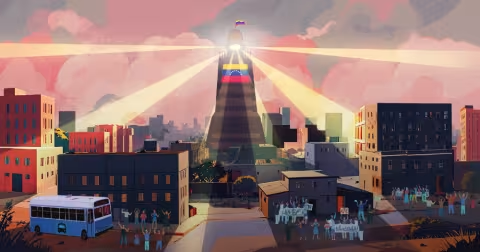
In a web of chaos and control, where media, technology, and legislation is weaponised to carry out mass surveillance, criminalise dissent, cancel passports and restrict news, women human rights defenders lead and participate in creative ways to resist.
For women activists, Venezuela is a laboratory of repression, but also resistance
For the past ten years, as a Venezuelan, I have been monitoring the human and digital rights situation in Venezuela—from the outside yet deeply immersed. I have colleagues and dear friends that have endured searches, imprisonment, exile, and torture, often silenced by fear or direct orders forbidding them from speaking to the media. Their stories surface only in fleeting moments—in private when we cross paths in a distant city or shared in disappearing messages on Signal.
Many of the experiences I recount here belong to those friends and colleagues whose stories I cannot share in full—or even in part—without putting them at risk. To protect them, their testimonies are intertwined, at times blurred together, preserving only the most crucial details. Even anonymity is not always enough. Some of these accounts come from those who have already left. Others, experts who helped shape this piece, remain inside, navigating a system that punishes even the smallest attempt to challenge power.
While these forms of technological repression affect the entire population, for women—particularly journalists, activists, women in politics, or those overtly critical of the government—they compound the structural discriminations they already face. Online harassment, digital surveillance, and doxxing are often gendered, targeting their bodies, their families, and their credibility in ways designed to humiliate and silence. These attacks are particularly vicious and aim to destroy their public reputation in ways their male counterparts are not subjected to—often through sexualised threats, smear campaigns, and attempts to discredit their professional and moral integrity. The fear of being identified—of having a photo or message used to justify state retaliation—adds another layer to the already immense personal cost of resistance. Even under anonymity, the risk continues to loom large. For many women, the choice is not only between speaking out or staying silent, but between exposure and safety. Being arrested carries the threat of mistreatment and torture, but for women, being sexually abused is almost a guarantee.
The Venezuelan government has built layers of threats to make repression difficult to denounce. Yet, full silence has not been achieved.
What is happening in Venezuela is not a single mechanism of repression but a web of chaos and control that weaponises technology and legislation. Exploring this web takes time, and a certain comfort with disorder, constant change, and contradictory information that defies common classifications. Laws are used to criminalise dissent, bureaucracy is weaponised to create fear and restrict movement, and digital tools enable both targeted repression and mass surveillance. Yet, women activists lead and participate in creative ways to resist, more on that towards the end.
A system of control based on media, legislation and technology
Venezuela’s descent into authoritarianism has been a gradual, carefully orchestrated process. The transformation of the media landscape is one of the clearest examples of how this process has played out. Independent media in Venezuela did not vanish overnight; it was dismantled in phases, reshaped by a slow erosion that turned legal technicalities into weapons against the press. It could be said that the shift began in 2009 with the forced closure of dozens of radio stations and the decision not to renew the broadcasting licence of RCTV, one of the country’s oldest and most widely viewed television networks. President Hugo Chavez, who branded himself as a revolutionary and anti-imperialist leader, accused the channel of having supported the 11 April 2002 coup attempt in which he was briefly overthrown.
Fast forward to 2024, a report from Venezuelan NGO Espacio Público counted over 400 media outlets being closed down. Ipys Venezuela also documented the phenomenon through a map of ‘information deserts’ where no independent media or non governmental information reaches vast amounts of the territory and millions of people. In certain towns, newspapers don’t exist in young people’s memories.
Legal censorship extended into the way laws were written and enforced, ensuring that dissent could be criminalised at any moment. The strategy was always the same: introduce vague and sweeping laws under the guise of maintaining order and protecting social peace, then apply them selectively to silence those who posed a threat to the government’s control. The Anti-Hate Law, passed in 2017, became one of the most effective tools for this. The law carries severe prison sentences for anyone accused of spreading messages of hate, discrimination, or incitement to violence, but what constituted a "message of hate" was left undefined.
In 2024, another law was introduced to target civil society organisations, this time under the pretext of transparency and financial oversight. The so-called Anti-NGO Law forced non-governmental organisations to register under strict government supervision, with vaguely worded provisions that allowed authorities to shut down any organisation at will. This, in the context of a complex humanitarian crisis, leaves many without crucial support in the face of a wide lack of response from the state. It also propulses more targeted ways to repress, going beyond institutions or organisations to surveil and repress individuals.
Passport: a privilege that can be revoked
In the latest phase of the crisis, I saw friends forced to flee through the land border with Colombia after discovering that their passports had been annulled. This measure, used systematically since 2017, saw a sharp increase in 2024, after the contested presidential elections of that year, targeting journalists, women human rights defenders, and activists both inside and outside the country.
For many, the discovery that their passport had been annulled came suddenly. Some learned about it when attempting to leave the country, only to be stopped at the airport and told they no longer had a valid travel document. Others, fearing that checking their status online might flag them for further scrutiny, chose not to look at all. The fear of triggering an alert was often enough to keep people in a state of uncertainty, reinforcing a system where unpredictability itself became a tool of repression. As human rights defender Luis Carlos Díaz explains, “even those who went to official offices to try and resolve the issue found themselves at risk, with reports emerging of individuals being detained on the spot by military counterintelligence agents. In some cases, they were interrogated, extorted, or subjected to physical abuse. Others simply disappeared into detention centres, their families left without answers.”
Díaz also highlighted the existence of silent alerts—hidden markers in immigration databases that do not immediately block a person’s entry but trigger a secondary review. If someone with a silent alert crosses a checkpoint, immigration agents are instructed to call a superior from an intelligence agency, who then decides whether the person should be detained or allowed to pass.
For those already abroad, having their passport annulled meant an indefinite exile. It was no longer just a question of whether they could return to Venezuela; it also dictated whether they could continue their lives elsewhere. Ana* (whose name has been changed to protect their identity), a human rights defender now living abroad described how the annulment of her passport severed any possibility of seeing her family again in the mid to long term. For others, the consequences went even further. Marianne Díaz Hernández, a digital rights specialist and an expert in digital ID and data protection at Access Now described how, despite her expertise, she found herself trapped in a system she had spent years warning others about. She did not have her passport annulled but will have significant challenges in getting a new one, particularly if the Venezuelan government continues, as it has, to pay attention to human rights defenders abroad: “I’m counting backwards,” she says, explaining that with each exit stamp in her passport she’s brought closer to the moment when she would run out of blank pages and be forced to remain in her country of residence, with little to no possibility of movement. “De facto statelessness”, she calls it.
For those in Venezuela learning that their passport was annulled meant carefully and discreetly planning an escape, crossing the porous borders with Colombia or Brazil. Those who had to flee explain that these borders tend to be dynamic, used daily by local populations to work, study, and shop. Blending in is possible, so long as one does not carry two large suitcases and attract the wrong kind of attention. This means one needs to quickly and silently leave everything behind for an unknown period of time. However, even that depends on Colombian and Brazilian immigration officers looking the other way and stamping an entry without demanding proof of exit. Sometimes it works. Sometimes it does not.
Thousands of passports have been revoked without warning, without a public announcement, without an identifiable pattern. They have targeted human rights defenders, journalists, political activists, and social media figures—but not all. That uncertainty, that arbitrary nature, is part of the strategy. Fear thrives in unpredictability.
Government apps and drones: a tool for snitching and surveillance
What was once primarily the work of intelligence agencies and security forces has now expanded into digitally enabled networks of snitching, crowd monitoring, and systematic tracking of dissent. The integration of mobile applications, community surveillance structures, and emerging tools like drones has allowed repression to scale in ways that were previously unthinkable.
Among the most striking examples of this shift is VenApp, an application promoted by the Venezuelan government as a tool for direct communication between citizens and state institutions. Initially, the government framed it as an e-government service platform developed by Tech & People Solutions SRL, a somewhat obscure company that has changed names and has also worked in collaboration with other companies based in Panama and the Dominican Republic that have worked on similar projects in those countries. VenApp was presented as a way for Venezuelans to file complaints about basic services, report infrastructure failures, or request assistance. However, from the moment it appeared, researchers like Iria Puyosa, from the Atlantic Council Democracy + Tech’s Initiative suspected it would serve a much darker purpose. “We imagined it would quite probably be used for surveilling users, to doxxing opposition sympathizers, and to geolocate protesters,” Puyosa said.
The post-electoral crisis in 2024 proved her right. By July 30, during the height of protests, Nicolás Maduro publicly announced that VenApp would now include an option to report individuals suspected of participating in “terrorist activities.” State-run media launched an informational campaign explaining how to use the app for these reports, encouraging government supporters to denounce protesters, opposition figures, or even neighbors who were perceived as anti-government. The government removed the app from major platforms just a day later, but the damage had already been done. Pro-government influencers, government-aligned networks, and state agencies had already spread the message that dissent was something to be reported.
Pro-government networks on Telegram, X (Twitter), and TikTok played a central role in amplifying this call for denunciation. Some groups began publishing “Wanted” posters featuring the faces of protesters, encouraging users to identify and expose them.
Luis Carlos Díaz described the pattern: “the problem wasn’t just VenApp itself—it was the intent. Community leaders tied to government food programmes and local PSUV (the government’s political party) organizers were already in a position to report people informally, but VenApp gave them a way to do it publicly. It formalized community snitching, allowing these structures to target activists and neighbors. In many cases, being reported meant losing access to gas, subsidized food, or other basic necessities. This wasn’t just surveillance—it was a form of micro-revenge after the government’s electoral defeat on July 28. The state enabled its last remaining loyalists to go after their own communities.”
For Lexys Rendón, co-director of Laboratorio de Paz, the use of surveillance and digital snitching systems disproportionately affects women living in poverty or with humanitarian needs, turning them into high-risk targets for multiple forms of violence, including coercion and control: “Their vulnerability is further compounded in contexts of territorial conflict or areas under the presence of irregular armed groups, where state and non-state actors exert pressure and surveillance simultaneously. A striking example is that of Captain Lisa Henrito, a Pemon Indigenous leader and Guardian, who became the target of surveillance, criminalization, and threats on social media—a case that illustrates how Indigenous women leaders face layered forms of violence that combine gender, ethnicity, and political repression.
All this takes place in a communication ecosystem in which women are specifically targeted when they become visible or more active as journalists, in political discussions, spaces of dissent and human rights defence. The pattern is not anecdotal—it is measurable and consistent. Monitoring by ProBox and the C-Informa coalition during Venezuela’s 2023 opposition primaries revealed that female candidates received 60% more online attacks linked to their gender than male candidates. These weren’t critiques of political platforms or policy stances, but gendered slurs and misogynistic taunts—terms like “mujerzuela,” (whore) “sayona,” (in reference to a local mythical creature of the night) “loca,” (crazy woman) or “qué buena que estás” (“you’re so hot”) flooded platforms like X (formerly Twitter), TikTok, Facebook, and YouTube. Valentina Aguana, from Venezuelan digital rights organisation Conexión Segura y Libre, confirms these patterns in her observations of social media interactions: “this is something that has been taking place for years, with consistent reputational attacks that don’t happen in the case of men.”
This constant barrage of targeted attacks—both sexualised and dehumanizing—not only seeks to discredit women’s intellectual and political capacities but also aims to erode their legitimacy as public figures. As political analyst Natalia Brandler put it, “In politics, words are used to disqualify women’s capacities and devalue them as people in the eyes of the public.”
During the protests contesting the results of the July election, Conexión Segura y Libre documented the presence of drones hovering above crowds, filming demonstrators from above. The purpose was not always clear, but the pattern was unmistakable—in many cases, the footage captured by these drones later appeared on government-aligned media and in social media spaces of government officials. Some videos zoomed in on individual faces in the crowds, creating a record of who was present and potentially marking them for future retaliation. The state-run broadcaster Venezolana de Televisión, along with Diosdado Cabello and other high-ranking officials, regularly shared drone footage of rallies, ensuring that opposition leaders and attendees knew they had been identified.
Conexión Segura y Libre has highlighted the capacity of these drones to focus sharply from long distances on specific individuals, suggesting a deliberate effort to identify and track demonstrators as part of a broader strategy of intimidation. The organisation documented several aerial recordings of opposition rallies where the government media emphasized close-up shots of protesters’ faces. One such instance occurred during a gathering in Caracas on August 3, when opposition leader María Corina Machado arrived face covered on a motorcycle to avoid identification but was filmed by a drone as she uncovered herself to step onto the stage. Similar footage was later shared from opposition demonstrations on August 17 and 28 in Caracas and other cities.
Conexión Segura y Libre also received social media reports indicating that between July 30 and August 3, 2024, drones were spotted flying over different areas of central Caracas at night, with visible lights suggesting they were searching for potential protest hotspots. Notably, drones were seen surveilling the city the night before Machado’s rally in the Las Mercedes district of Caracas. The use of surveillance technology was visibly documented not only through official government posts boasting about filming the protests but also through anonymous whistleblowers who provided photos of the drones themselves.
Among the incidents documented by Conexión Segura y Libre was the Gran protesta mundial (the “great world protest”) on August 17, when social media users in Valencia, Carabobo, shared with the organisation images of the drone operator. Based on images analysed directly by Conexión Seguria y Libre and user-generated reports, the organisation identified with high confidence the use of drones from the Autel Robotics Enterprise series, designed for government and corporate applications. Further analysis of the materials led them to conclude that the likely models used were EVO Max N4 or T4. These high-performance quadcopters differ from consumer-grade or videography drones. According to the manufacturer, these models are designed for infrastructure monitoring, search and rescue operations, and law enforcement applications.
How the resistance navigates the information war
One of the biggest obstacles for independent media in Venezuela is simply remaining accessible. Between 2016 and 2025 Venezuelan digital rights organisation Conexión Segura y Librehas identified 228 blocked domains, of which 180 are active, and 89 belong to digital media outlets. Alternative domains linked to the same website are a strategy to diversify access points and attempt to circumvent censorship.
VPNs remain one of the most widely used tools to evade these restrictions, allowing users to access blocked content by routing their internet traffic through external servers. But VPNs alone are not a sufficient defence. Many Venezuelans lack the technical knowledge, the resources, or even the stable internet connections required to use them effectively.
This gap has led to the emergence of projects designed specifically to keep information flowing despite digital censorship. One such initiative is Noticias Sin Filtro (‘unfiltered news’), a platform designed to help Venezuelans access blocked news sites without requiring them to set up VPNs themselves. Developed by Conexión Segura y Libre, the app was launched just one week before the July 28 elections, at a moment when information control was at its most aggressive. Built into different VPN systems, it allows users to read and listen to news from blocked media outlets with minimal technical barriers.
According to its director, Andrés Azpúrua, it would be extremely difficult for the government to block the application entirely because of its decentralized infrastructure. Many independent news platforms see it as a crucial tool for regaining lost audiences. Whenever a site is blocked, its readership inside Venezuela drops dramatically, as domestic traffic is cut off and only those using VPNs can access it. Apps like Noticias Sin Filtro are not just about convenience; they are a response to the state’s efforts to keep people in the dark.
With digital access increasingly restricted, alternative models of news distribution have also emerged, bringing information back into physical public spaces. One such initiative is El Bus TV, which was created as a way to bring news directly to people in public spaces. Instead of relying on digital access, it functions as a mobile news service, spreading information in a way that is difficult to be blocked or filtered. The idea is simple: journalists and communicators ride city buses, reading or announcing important news stories, providing passengers with updates on events that they would otherwise struggle to access.
El Bus TV and Conexión Segura y Libre also collaborate closely. Through digital security trainings and shared working methods, both organisations maintain a strong presence in communities. During these events, members of El Bus introduce the Noticias Sin Filtro app and explains how it can be used to access blocked news sources safely and easily. Through regular visits and in-person meetings—with particular attention to elderly residents– Conexión Segura y Libre can have a qualitative approach to the reception of the apps. According to Valentina Aguana, women seem to have a leading presence during these activities and are particularly receptive to the advantages of the app.
A similar effort led by independent outlets like El Pitazo, Tal Cual y Runrunes, ARI Móvil (which stands for Alianza Rebelde Investiga -”Rebel Alliance Investigates” ) takes this concept further. ARI Móvil operates as a mobile news truck that serves three different digital media outlets. These vehicles drive through communities, delivering news to people who no longer have access to independent reporting.
As seen before, these initiatives do not work in isolation. In many cases, independent journalists, fact-checkers, and grassroots communicators collaborate, using informal networks of information sometimes supported by citizens through WhatsApp, to spread reliable information and counteract government disinformation. When official channels flood the airwaves and social media with manipulated narratives, these networks act as decentralized fact-checking systems, correcting false information, verifying sources, and ensuring that at least some parts of the population remain aware of what is happening.
These strategies have become a form of resilience, evolving in response to the constant government control. People are not only learning how to access information despite restrictions but also developing new ways of protecting themselves and their networks. In a country where digital surveillance is widespread and social media activity can lead to real-world consequences, knowing whom to trust, where to get reliable information, and how to share it safely has become a necessary skill.
This ecosystem of information resistance could even be seen as a kind of laboratory—a constantly evolving system in which new methods of censorship are met with new methods of evasion; where the very act of seeking out news has become a form of quiet defiance. It is an ongoing process of adaptation, shaped by necessity and by the shared understanding that in Venezuela, access to information is not just a right—it is a rightful act of counterpower.