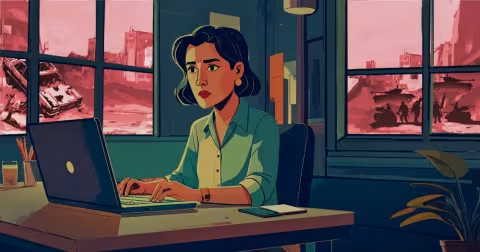
With technology weaponized against them, Lebanon’s women human rights defenders are finding creative ways to support an estimated 520,000 women and girls displaced by war.
Yumna Fawaz was asleep when a thunderous blast jolted her awake.
She was in Hasbaya, a mixed-faith town in southern Lebanon, on October 25, 2024, with 17 other journalists and media workers covering the intensifying conflict between Israel and Hezbollah. “We were the last group there,” Fawaz recalled. “We were headed to the frontline.”
At 3 a.m., a missile strike hit their location. “For a second, I thought I was dead,” she said. The ceiling was gone, Israeli jets roared overhead, and around her lay dismembered bodies. “Legs, parts of bodies, pieces of meat,” she said, struggling to describe the carnage.
Then came another strike. As chaos unfolded, Fawaz made a split-second decision: she went live on air. “As journalists, we prefer to die while working,” she said. She continued broadcasting until 8 a.m., when it was finally safe to emerge from the rubble.
A location-targeted night of horror
Fawaz is one of the survivors of the deadliest attack in Lebanon in ongoing aggression by Israel. The October 2024 attack killed Ghassan Najjar, a cameraman; engineer Mohamed Reda from the news channel Al Mayadeen, a pro Iranian outlet; and cameraman Wissam Qassem from Al-Manar, Hezbollah’s media channel. Three others were wounded. “I’ve covered many wars in my lifetime, in Syria, Iraq, Yemen and so on,” she said. “But this was different. Israel knew what they were doing. They used new technology and attacked with weapons made by the U.S. To kill journalists while they’re sleeping – this was a whole new level of barbaric. This attack showed that unlike the previous wars, there is no red line with this one.”
With Israel’s war on Hezbollah escalating in Lebanon and technology increasingly used to target individuals, women human rights defenders and journalists are operating under unprecedented danger. Facing threats from both foreign aggression and domestic political forces, they are navigating surveillance, displacement, economic insecurity, and mental trauma while trying to protect and support over half a million displaced women and girls. But women human rights defenders in Lebanon are surviving—and resisting—amid a collapsing system.
Technology as a weapon: Israel’s escalating strategy
The attacks shook the journalist and human rights defender community in Lebanon, not only altering the behavior of media outlets and human rights defenders, but also how the war is or is not responded to. “[The attack] was a huge deterrent,” Jonathan Dagher, who leads the Reporters Sans Frontiers (RSF) Middle East Desk said. “It was understood as a very clear message that no one is out of bounds. They will be targeted, directly and almost without hesitation.”
Alongside its war on Gaza, which has been on since October 2023, Israel’s attacks in Lebanon escalated into an all out-war last September when it carried out waves of airstrikes and covert weaponized pager and walkie-talkie attacks targeting Hezbollah that killed 39 in homes and public places and wounded more than 3,400. Two Western security sources said Israeli intelligence agency Mossad spearheaded the pager and walkie-talkie attacks.In the pager attacks, Israeli forces used an advanced AI tool called ‘Habsora’, which maintains a “target bank” that catalogues Hezbollah operatives and their locations. This created an even bigger fear that personal devices used for crucial communication could be made into killing machines.
The fighting has killed over 4,000 people in Lebanon since October 2024, and the war in Lebanon has displaced an estimated 520,000 women and girls, according to UN Women, which added that 12,000 families that were displaced are headed by women. Human rights organisations note that the conflict has been specifically deadly and disruptive for media workers and women human rights defenders, who’ve faced increased challenges with using or trusting technology, since technology itself has been weaponized. Lebanon’s women human rights defenders are finding ways to support communities, despite the targeted threats to journalists and Hezbollah.
Dangerous access, heightened risk for women
One of the biggest challenges for human rights defenders and media workers while working during a war, said Ramzi Kaiss, a researcher with Human Rights Watch (HRW) with a focus on the Middle East and North Africa division, is access, and women have faced more barriers than men.
“Access is key because it’s needed to build the facts,” said Kaiss. “What we saw during the last war, particularly the escalation, was that there were warning signs for people who work on documenting violence, that if you’re documenting what’s going on in the ground, you may become a target.”
Kaiss has been a part of multiple HRW investigations documenting Israel’s targeted technology-driven location attacks on media and aid workers in Lebanon in the last 15 months, including the one that killed Najjar, Reda and Qassem last October. Israel has consistently denied HRW’s investigations, calling them false.
Ramzi said that the risks in a war are often compounded when it comes to women, be it in journalism, or human rights or any other field. “In a country like Lebanon, where, already in peace times, there exists discriminatory laws against women, especially ones that don’t protect them from physical and sexual abuse, reporting on war becomes even more challenging for women,” said Ramzi.
Women and the war’s toll and trolls
Women media workers in Lebanon have historically faced discrimination and harassment within close quarters, especially the Lebanese political parties. The recent past has seen Lebanese women journalists being compelled to flee the country, or being imprisoned for their work. RSF’s press index places Lebanon 140th out of 180 countries in terms of press freedom. The media industry in the country already has gender bias.
A report released this March, Maharat Foundation, with the support of UN Women (Lebanon) and the French Embassy in Beirut, further found that women journalists and human rights defenders working in the frontlines are increasingly facing cyber violence. A jarring example of this emerged after Lebanese-Syrian journalist Alia Mansour was detained by the Lebanese police on October 19, 2024, for a few hours after a social media account impersonating her allegedly interacted with Israeli counterparts. Lebanese law prohibits citizens from interacting with Israeli citizens.
Another report by the Committee to Protect Journalists found “dozens of social media posts” targeting local media outlets by asking for a ban on them, or burning down their news studios. Some of the outlets attacked had aired pieces that many locals deemed insensitive or provocative. The Lebanese government has also had a record of weaponizing criminal laws to crack down on independent media outlets. “The idea [behind these moves] is to silence journalists and human rights defenders and stop reporting on violations or allegations of violence or financial mismanagement or corruption,” said Ramzi.
Elsy Moufarrej, a human rights defender and journalist, is the coordinator for the Alternate Press Syndicate, which has worked with multiple media and humanitarian organisations such as the RSF to provide protective gear to Lebanese media workers headed to the frontlines. She notes that apart from facing daily assault by the Israeli targeted attacks, there are numerous pressures in Lebanon itself.
“There was the issue of media houses not providing insurance, while freelancers faced issues with press accreditation and identification,” she said.
Early this year, Moufarrej’s work to support media workers got her dismissed from MTV Lebanon, where she worked as a content producer and debate and advocacy coordinator. Her dismissal came for her union work, which, in this case, was a statement by the syndicate that criticised MTV Lebanon for getting women journalists arrested because they accused the company of allegedly providing information that could have potentially helped the Israeli military. Moufarrej, according to local news reports, was asked to either retract the statement, or resign from the syndicate.
Moufarrej said she now faces a smear campaign over her dismissal. “This has made our work to support journalists really hard,” she said.
Maharat Foundation, in a report last year, further noted the role Israeli propaganda played in its psychological warfare in Lebanon alongside its military tech, by using digital platforms including X to push manufactured or biased information for Lebanese civilians. The report found several lapses by Lebanese media for falling for Israeli propaganda. At the same time, Western newsrooms such as CNN, ABC and NBC embedded with the Israeli military to cover the war, raising questions not just about its ethicality, but also its impact on Lebanese journalists. “Local journalists who worked with these newsrooms were assumed to support Israel too, and its occupation,” says Moufarrej, adding that the same was assumed for media institutions controlled by Hezbollah.
Besides problems from the state, women face their own challenges with Hezbollah. “We had reporters who had trouble reporting in areas governed by Hezbollah,” Moufarrej said.
Operating under Hezbollah’s shadow
Hezbollah’s power and influence in Lebanon has led to the Shia Islamist militia and political group being labelled as a ‘state within a state.’ Hezbollah was founded in 1985 with financial support from the Iranian Revolutionary Guard Council (IRGC) in response to Israel’s invasion and occupation of southern Lebanon. Over the years, the movement became the country’s most prominent representative of the Shia community, partially due to its effectiveness in fighting Israel and partially because of its authoritarian nature. The group used violent tactics to subdue opponents, including alleged assassinations, until it came to monopolize the resistance to Israel.
The party, however, also drew intense fealty among its support base. Its popularity grew, in Lebanon and the entire Middle East, after the liberation of south Lebanon from Israeli occupation in 2000. It also ran social and political services, like healthcare to supporters and running a media office.
For years, journalists and human rights defenders wanting to report or work in areas where Hezbollah is present required accreditation or authorization from the party. These areas include almost all parts of Lebanon that are predominantly inhabited by Shia Muslims, including Beirut’s southern suburbs, large swathes of southern Lebanon and the Bekaa Valley in the east.
During this latest war, that meant to cover events in south Lebanon, journalists needed accreditation from Lebanon’s Ministry of Information, the Lebanese Army, and Hezbollah, and human rights defenders needed to check in with Hezbollah, which was rightly paranoid after the deadly pager attacks.
At times, getting answers from Hezbollah was difficult as their point press person was so reportedly inundated with calls and messages that many went unanswered. This led to many journalists going to cover events without Hezbollah’s permission.
Hezbollah doesn’t appreciate that in the best of times. But after a two week period in late September 2024 that saw hundreds of electronic devices explode, an intensification of aerial Israeli attacks that killed more people in Lebanon in any single day since the end of the civil war in 1990, and the assassination of a number of top Hezbollah leaders — including their longtime Secretary General Hassan Nasrallah, the group’s fears were existential.
“We seem to be living in a Netflix series or in a dystopia,” a political analyst said at the time.
Jad Shahrour, Communications Officer at Samir Kassir Foundation, which focuses on press freedoms in the Middle East, said Hezbollah detained some foreign journalists and confiscated mobile devices, sometimes only returning them after a few days.
Analysts and media reports suspected Hezbollah had been infiltrated by spies or agents and the group became more frantic in its treatment of the press.
The journalists that were detained “refused to go public because they wanted to keep covering” the war, particularly in areas where Hezbollah has a presence, Shahrour said.
“The whole process is wrong,” Shahrour said. “There should be a call centre or a hotline that gives accessibility fast and online. It’s not acceptable that a fixer has to go to the army, Hezbollah and the ministry.”
The unequal fight for access
Many journalists hesitated going south while rising insurance costs made deploying reporters too expensive for many outlets. “Independent journalists stopped going [to cover the south],” Dagher said. “Global media outlets and big agencies started to think twice and took a lot more precautions.” This, Daghar adds, is intentional. “The intention of the Israeli forces to impose a media blackout on the conflict zones was clear from the get-go,” he said. “There was also an intention to impose a blackout on the south, and for a while it worked.”
Angie Mrad, an Emmy-winning freelance journalist and producer from Lebanon found her status as a freelancer highly disadvantageous when she couldn’t get proper accreditation. At one point, she was filming in a private citizen’s home when a local politician’s henchmen burst in and temporarily detained her colleague who was filming. Mrad has since had multiple meetings with the Information Ministry in the hopes of obtaining rights for freelance journalists but, “it was extremely difficult for journalists to work during the war and obtain the necessary permissions.”
Moufarrej, from Lebanon’s Alternate Press Syndicate, lists the many ways the war specifically impacted women media workers, especially in the form of displacements. There’s one case, she said, where a woman journalist was forced to move into her former husband’s house after getting displaced, which has been very triggering for her and her daughter. The journalist told Moufarrej that she works from her car in order to do her work. Some journalists, she added, face rent-gouging from landlords while one journalist faced rental discrimination for being a Shia Muslim. Yet another slept on the streets after being displaced in the south. These cases found support from the Alternate Press Syndicate but Moufarrej said that the scale of impact especially on women reporters is unfathomable. “These journalists have to work no matter what situation they’re in,” she said.
Kaiss, from HRW, said that the risks during this time extends beyond the human rights defenders and journalists too, to those who help them document war crimes.
“We’ve documented the targeting of medical workers and teams who were interviewed by us. By the time we published our report, they had unfortunately been killed in targeted attacks,” he said. The Lebanese Ministry of Health found that between October 2023 and November 2024, the Israeli military attacked 67 hospitals, 56 primary healthcare centres and 238 emergency medical teams. At least 222 medical and emergency relief workers have been killed in those attacks. In March this year, Amnesty reiterated the killings as war crimes and demanded the International Criminal Court to investigate.
The silent mental health crisis
The scale of the war, the burden of their work and the killings of their peers and family have placed an unimaginable trauma on many survivors.
Fawaz can’t stop reliving the scene from October 2024. “One day, I woke up in my house in Beirut after hearing a huge sound of bombardment,” she said. “I took my phone and hurried to my window to look outside. There was nothing. It was all in my head.” The journalists and human rights defenders APC spoke to in this report couldn’t respond to how they protect their own mental health while documenting the war.
Moufarrej said that the biggest impact she’s had from her work is on her mental health. “I’m a single mother and I have a nine-year-old daughter. But dealing with the traumas of my colleague doesn’t go down easily. There’s no time to grieve even when we see everyone around us fall one by one. It’s not been easy.”
Theatre as resistance and healing
Farah Wardani, who interperses social activism and theatre at her studio called Laban in Beirut, said that working with internally displaced persons during this conflict, especially in the south, brought forth a critical message that there’s the dire need to address the impacts on women. “In a conflict situation, women and children are the most vulnerable,” she said.
“Usually in times of crisis, women are the primary caregivers and they have to stay strong for the rest of the community. In my country, it’s an ongoing series of wars, violence and financial crisis, and these women do so much to not just survive but also to keep their families and communities together. You see an entire generation of women suffering from burnout and trauma, where they don’t have the time to breathe and reflect.”
Wardani lost 15 family members in south Lebanon during the full-scale war last year. “My own children are afraid; some from my crew have spent nights on the streets after being displaced. I’m in therapy myself, as are all my team members. But we can’t stop. Trauma kills one’s imagination and sense of reality. It’s important for me to be around my community.
Wardani and her team at Laban have been conducting theatre workshops and other forms of expressions to provide women a way to express themselves, while also focusing on children in order to “provide a space for women to rest.”
“We are witnessing what’s happening in Gaza and there is a deep fear in Lebanon that we will become like Gaza too. There’s a lot of unexplained anger, a feeling of unfairness among those affected by the violence,” said Wardani. “But we’re also witnessing how, despite facing so much, women are natural peace builders and act as psychologists by handling the emotions of everyone around them. We can’t stop now.”
And that’s how Fawaz feels too. “I feel like I’ve been killed many times,” Fawaz said. “But when I think of how I can survive this, I say that I’m not a victim – I’m a survivor. And I want to tell our story to the whole world. If nobody talks about this, there will be no accountability.”